
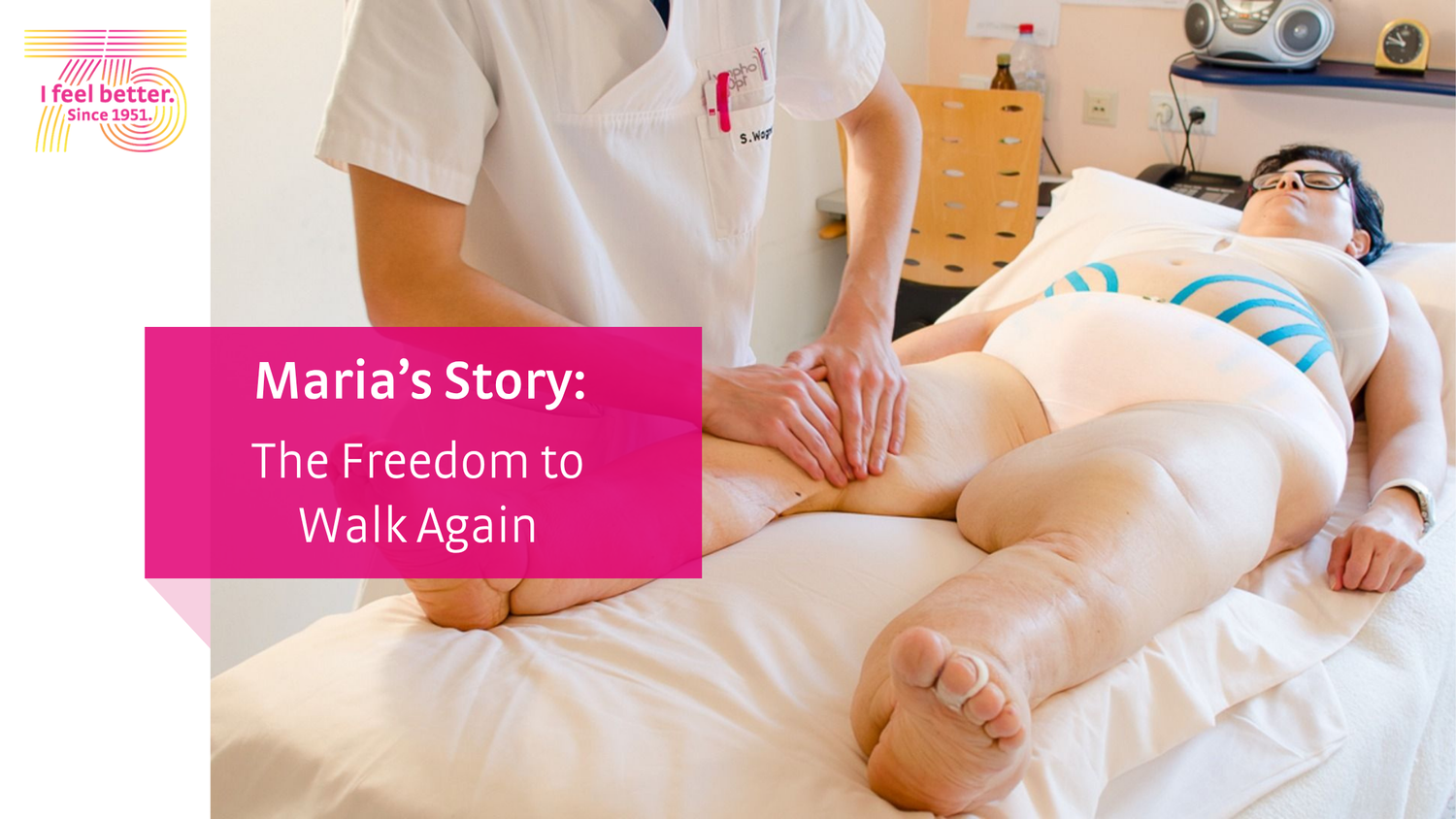
For ten years, Maria Bordonado's world was the size of a bedroom.
At nine years old, Maria noticed her feet and knees had started to swell. Her shoes stopped fitting. Her parents assumed it would pass, but it didn't.
What began as unexplained swelling slowly progressed into elephantiasis, the most severe form of lymphoedema. While her friends grew up, finished school, started careers and families, Maria's condition kept getting worse. Doctor after doctor had no answers. Eventually, her legs became so heavy and swollen that walking even a short distance took everything she had. She stopped going out. Then she stopped leaving her room at all.
This is where some stories about severe lymphoedema stop — the sense that nothing can be done, but Maria's story doesn't stop there. It's what happened next that we want people living with lymphoedema today to hold on to: no matter how dire things feel, there is always a next step worth taking.

A Story that Found its Way to medi
In 1998, a Spanish doctor published details of Maria's condition online, hoping someone, somewhere, might be able to help. It reached Nati Velázquez, manager of medi's Spanish office.
Nati brought Maria's story to Dr Franz-Josef Schingale, a lymphoedema specialist in Germany who believed he could help her. But there was a problem: Spanish health insurers wouldn't fund the treatment, and the cost of care, travel and time away was too much.
When medi's staff heard what Maria was facing, they didn't hesitate. The budget set aside that year for customer Christmas gifts was redirected to fund her treatment. German TV networks picked up her story and the public responded too, donating to get her to Germany.
By the end of January 1999, everything was arranged. Maria travelled almost 2,000 kilometres by ambulance, lying down for the entire journey from her home near Alicante to the Lympho-Opt Klinik in Hohenstadt, Germany. She needed several people to help lift her out of the vehicle.
But finally her wait was over, and her treatment could finally begin.
The Six Months that Changed Everything
Maria stayed at the clinic for six months, undergoing daily manual lymphatic drainage, intermittent pneumatic compression therapy, mobilisation treatment and compression garments. It was consistent, patient, dedicated care, and it worked.
By the end of her stay, the circumference of Maria's calf had reduced from 157 centimetres to 52 centimetres. Across her legs, she lost more than 86 kilograms in retained fluid. She could walk again, and for someone who had spent ten years confined to two rooms, that first walk was everything.

Maintaining her Progress on Her Own Terms
Maria returned to Germany for follow-up treatment several times over the following years, most recently travelling independently by air rather than needing to be transported. Dr Schingale, who has treated Maria for 15 years, has been consistently impressed not just by her results, but by her discipline in maintaining them.
Back home in Spain, without regular access to manual lymphatic drainage, Maria manages her condition herself: wearing mediven compression stockings every day.
On her most recent visit, Maria was fitted with a multi-part compression garment system, including toe caps, thigh-length stockings and capri shorts, designed to provide the measurable and sustained compression she needs while making daily donning and doffing easier to manage on her own.
Why Maria's Story Matters
Maria's outcome wasn't the result of one treatment or one moment. It took a specialist who believed she could still be helped, a therapy network that could deliver consistent, coordinated care, a community that rallied around her when the system couldn't, and, most of all, Maria's own refusal to stay where she was.
That combination is what we hope every person living with lymphoedema can find: the right care, a support network that doesn't give up on you, and the belief that improvement is still possible, even after years of feeling like it isn't.
If you're at the start of your lymphoedema journey, in the middle of a hard stretch, or supporting someone who is, Maria's story is a reminder that severe doesn't mean permanent, and that you don't have to face it without support.
medi. I feel better.

Living with lymphoedema or supporting someone who is?
Talk to your GP, lymphologist or vascular specialist about a treatment plan that's right for you, and explore medi's range of compression therapy solutions.



Leave a comment
All comments are moderated before being published.
This site is protected by hCaptcha and the hCaptcha Privacy Policy and Terms of Service apply.